Which Solar Inverter to Choose? 2026 Guide
Confused about solar inverters? Learn about String, Micro, and Hybrid inverters. Simple guide to help you pick the right inverter for your Indian home.
You've picked your solar panels. Great! But panels alone don't power your home. You need an inverter — the brain of your solar system.
The inverter converts the DC power from your panels into AC power that runs your TV, AC, fridge, and everything else at home.
In this guide, we'll explain the different types of inverters and help you choose the right one for your home.
Haven't chosen your panels yet? Read our guide to choosing solar panels first.
What Does a Solar Inverter Do?
Solar panels produce DC (Direct Current) electricity. But Indian homes run on AC (Alternating Current).
The inverter sits between your panels and your home, converting DC → AC in real-time. It also:
- Tracks how much power you're generating
- Manages power flow to grid or battery
- Shuts down safely during faults
- Connects to your phone app for monitoring
Types of Solar Inverters
There are three main types of solar inverters. Each has its own pros and cons.
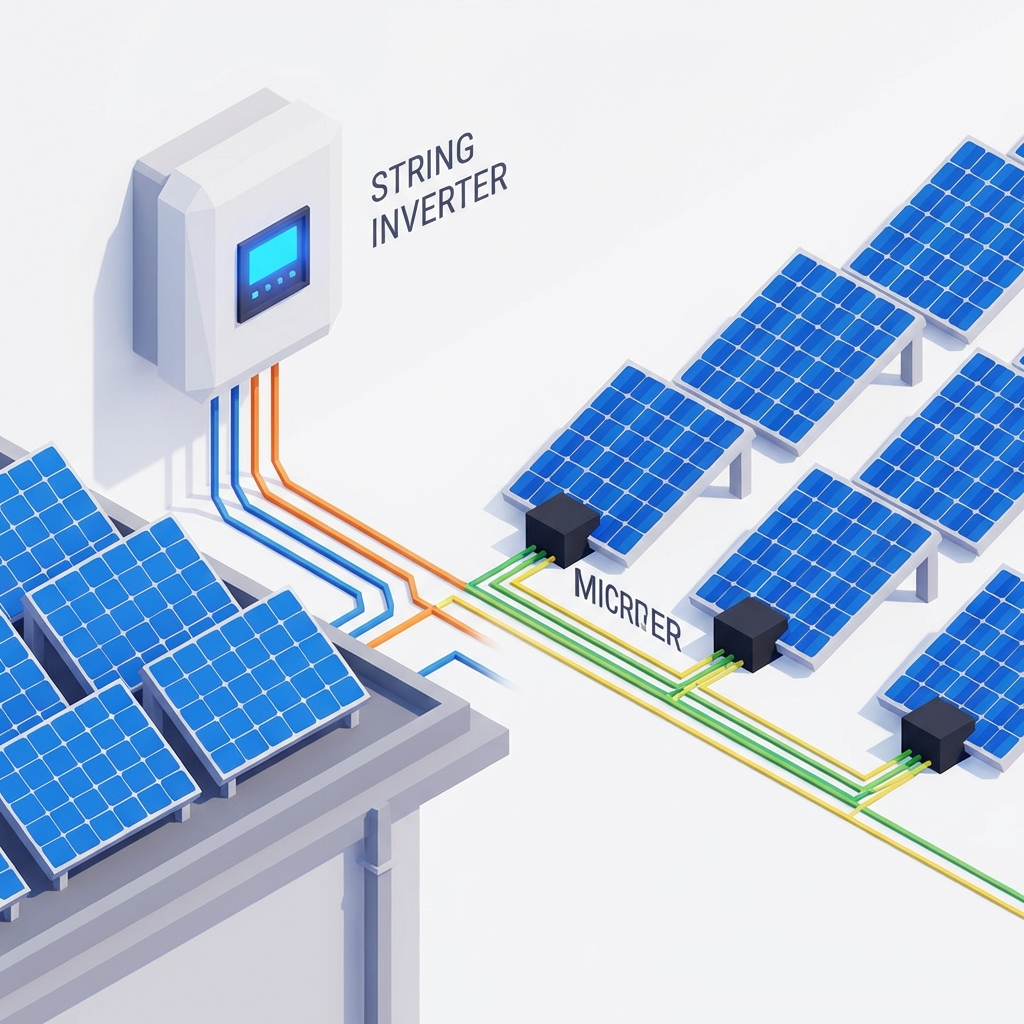
1. String Inverter (Our Recommendation)
A string inverter is a single box that connects to all your solar panels. All the panels are wired together in a "string" and feed into this one inverter.
✓ Pros
- •Lowest cost option
- •Simple installation
- •Easy to maintain (one unit)
- •Proven technology, very reliable
✗ Cons
- •If one panel is shaded, all panels perform worse
- •Single point of failure
- •No battery support (basic models)
Best for: Homes with unshaded roofs, budget-conscious buyers, simple installations.
2. Micro Inverter (Premium Option)
A micro inverter is a small inverter attached to each individual panel. Each panel works independently.
✓ Pros
- •Each panel works independently
- •Shade on one panel doesn't affect others
- •Better monitoring (panel-level data)
- •Easy to expand system later
✗ Cons
- •Highest cost (one inverter per panel)
- •More components to maintain
- •Not common in India yet
Best for: Roofs with partial shading, complex roof shapes, those who want maximum efficiency.
3. Hybrid Inverter (If You Need Battery)
A hybrid inverter combines a regular inverter with a battery charger. It can work with the grid AND charge batteries.
✓ Pros
- •Battery ready (add batteries anytime)
- •Power backup during outages
- •One device for everything
- •Future-proof investment
✗ Cons
- •Slightly higher cost than string inverter
- •Battery adds extra cost (optional)
Best for: Homes with frequent power cuts or those who need uninterrupted power backup.
On-Grid vs Off-Grid
Another important choice: do you want to stay connected to the electricity grid or go completely independent?
On-Grid vs Off-Grid: Where Does Your Power Go?
- ✓ Export extra power, get bill credit
- ✓ Lower cost (no battery needed)
- ✗ No power during grid outage
- ✓ Complete power independence
- ✓ Works during grid outage
- ✗ Higher cost (batteries expensive)
On-Grid (Grid-Tied)
Your solar system stays connected to the DISCOM (electricity board). When you generate more power than you use, it goes to the grid and you get bill credits (net metering).
- Pro: No battery cost needed
- Pro: Get paid for extra power
- Con: No power during grid outage (safety rule)
Off-Grid (Standalone)
Your solar system is completely independent. All power is stored in batteries. No connection to the grid.
- Pro: Complete independence
- Pro: Power during any outage
- Con: Expensive (big battery needed)
- Con: No net metering benefits
Inverter Sizing: How Big Should It Be?
Inverter size should match your panel capacity. Here's a simple guide:
| Panel Capacity | Inverter Size | Typical Home |
|---|---|---|
| 2-3 kW | 2-3 kW | 1-2 BHK, small family |
| 4-5 kW | 4-5 kW | 2-3 BHK, medium family |
| 6-10 kW | 6-10 kW | Large home, multiple ACs |
Rule of thumb: Inverter capacity should be equal to or slightly less than your total panel capacity.
Brands Available in India
Here are reliable inverter brands with good service networks in India:
| Brand | Type | Warranty | Notes |
|---|---|---|---|
| Growatt | String, Hybrid | 5-10 years | Popular, good value |
| Sungrow | String, Hybrid | 5-10 years | Large global brand |
| Goodwe | String, Hybrid | 5-10 years | Reliable, good app |
| Fronius | String | 5-10 years | Premium European brand |
| Enphase | Micro | 10-25 years | Best micro inverters |
SolarWire Recommendation
What We Install for Our Customers
For most Indian homes, we recommend a simple On-Grid String Inverter. It's reliable, cost-effective, and more than enough for typical residential solar installations.
- ✓Lowest cost, best value for money
- ✓Proven technology, very reliable
- ✓Easy maintenance (single unit)
- ✓Net metering for bill credits
We work with proven brands like Growatt, Sungrow, and Goodwe. All come with 5-10 year warranties and excellent after-sales support in India.
If you have frequent power cuts and need backup, we can set up a Hybrid Inverter with battery storage. Talk to us about your specific needs.
Next Steps
Now you know which inverter to choose: On-Grid String Inverter is the best option for most homes — simple, reliable, and cost-effective.
Ready to see how much you can save? Use our free calculator to get an instant estimate based on your electricity bill.
→ Calculate Your Solar Savings
Have questions about inverters or your specific situation? Our team is happy to help.