On-Grid vs Off-Grid vs Hybrid: Which Solar is Best?
Confused between On-Grid, Off-Grid, and Hybrid solar systems? Learn the key differences, costs, and which system works best for Indian homes.
When planning a solar installation, one of the first decisions you'll make is: should I go On-Grid, Off-Grid, or Hybrid?
This choice affects your cost, electricity bills, and whether you'll have power during outages. Let's break down each option in simple terms.
Already know you want solar panels? Check our guide to choosing solar panels and our guide to choosing inverters.
The Three Types of Solar Systems
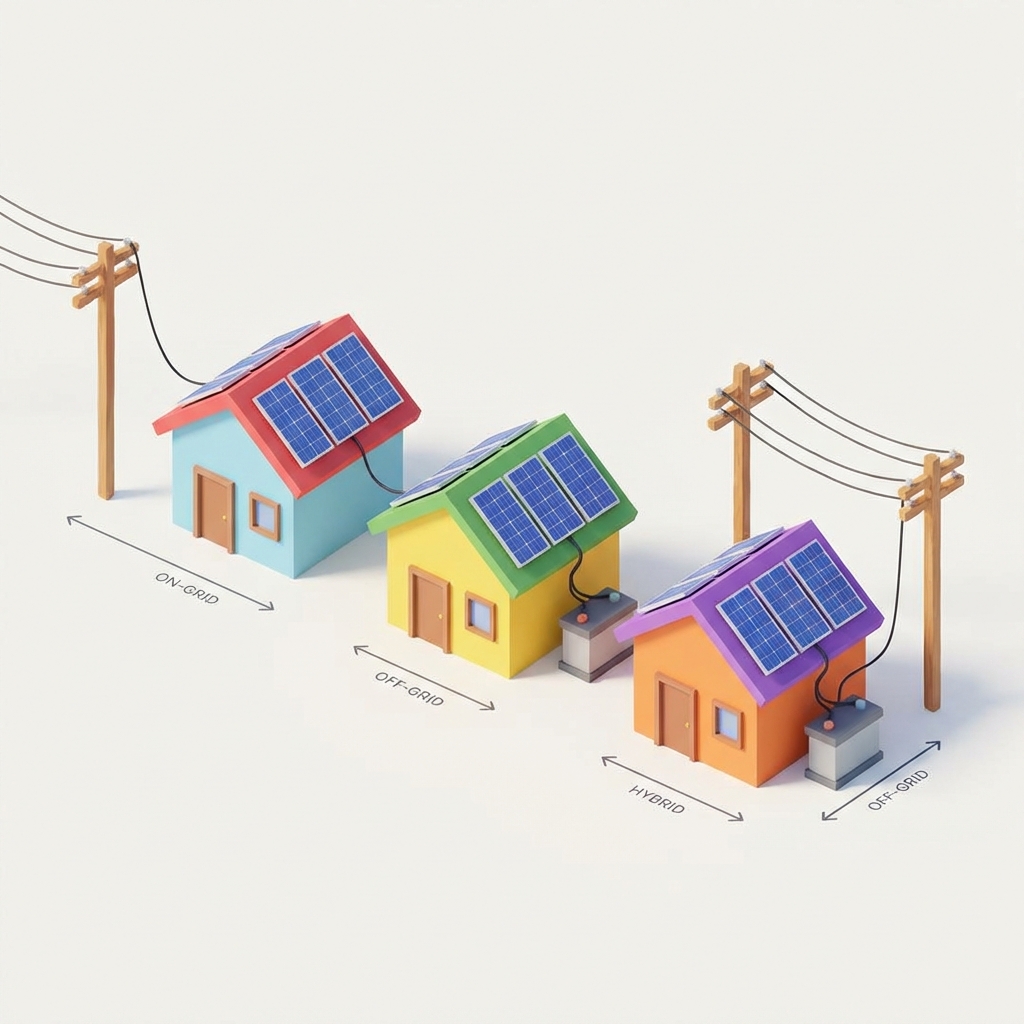
1. On-Grid (Grid-Tied) — Our Recommendation
An On-Grid system stays connected to your local electricity grid (TNEB, BESCOM, etc.). Your solar panels generate power during the day, and any extra electricity flows to the grid.
In return, you get net metering credits — essentially, the grid pays you for the power you send. At night or on cloudy days, you use grid power, but your credits offset the cost.
✓ Pros
- •Lowest cost — no batteries needed
- •Net metering gives you bill credits
- •Fastest payback period (3-5 years)
- •Less maintenance (no battery replacement)
- •Government subsidies available
✗ Cons
- •No power during grid outages (safety rule)
- •Depends on net metering policy in your state
2. Off-Grid (Standalone)
An Off-Grid system is completely independent. It has no connection to the electricity grid. All the power your panels generate goes into batteries, and you use that stored power 24/7.
✓ Pros
- •Complete energy independence
- •Power during any outage (no grid dependency)
- •Good for remote areas with no grid
✗ Cons
- •Very expensive (large battery bank needed)
- •Batteries need replacement every 5-10 years
- •More maintenance required
- •No net metering benefits
- •If batteries run out, no power at all
Best for: Remote farmhouses, hill stations, or areas where grid connection is not available or extremely unreliable.
3. Hybrid (Grid + Battery)
A Hybrid system combines On-Grid and Off-Grid. It stays connected to the grid for net metering, but also has batteries for backup during power cuts.
✓ Pros
- •Best of both worlds — grid + backup
- •Power during outages
- •Net metering still available
- •Can be expanded later
✗ Cons
- •Higher cost than On-Grid (battery + hybrid inverter)
- •Battery maintenance and replacement costs
- •More complex system
Best for: Homes with frequent power cuts (2+ hours daily) who also want net metering benefits.
Cost Comparison
Here's how the costs stack up for a typical 5 kW system:
Cost Comparison (5 kW System)
* Approximate costs. Actual prices vary by location and components.
| System Type | Approx. Cost (5 kW) | Battery Cost | Payback Period |
|---|---|---|---|
| On-Grid | ₹2.5-3.5 lakh | None | 3-5 years |
| Hybrid | ₹4-5.5 lakh | ₹1-2 lakh | 5-7 years |
| Off-Grid | ₹6-8+ lakh | ₹3-5 lakh | 8-12 years |
As you can see, On-Grid has the fastest payback and the lowest cost. The savings are even better when you factor in net metering credits.
How Net Metering Works
Net metering is the biggest advantage of On-Grid solar. Here's how it works:
How Net Metering Saves You Money
Meter runs backward = Credits
Credits offset your bill
- Daytime: Your panels generate more power than you use. The extra goes to the grid, and your meter runs backward, giving you credits.
- Nighttime: You use power from the grid, but your credits offset the bill. Many months, you pay almost nothing!
- Annual settlement: At year-end, if you have excess credits, some states pay you for them.
What About Power Cuts?
The main concern people have with On-Grid: "What happens during power cuts?"
The honest answer: On-Grid systems shut down during grid outages. This is a safety feature to protect linemen working on the grid.
But here's the reality:
- Most urban areas have 1-2 hours of outage per day (if any)
- Power cuts usually happen when you're not home (scheduled maintenance)
- The money you save with On-Grid can buy a small inverter+battery backup for essential loads
Which One Should You Choose?
| Your Situation | Best Choice |
|---|---|
| City/town with grid connection, rare power cuts | ✓ On-Grid |
| Some power cuts (1-2 hrs/day), want backup | On-Grid + small inverter |
| Frequent long power cuts (4+ hrs/day) | Hybrid |
| No grid connection (remote area) | Off-Grid |
| Want 100% independence from grid | Off-Grid (expensive) |
SolarWire Recommendation
What We Install for Our Customers
For 95% of homes in cities and towns, we recommend On-Grid Solar. It's the most practical and cost-effective choice.
- ✓Lowest cost — no expensive batteries
- ✓Net metering saves more than batteries
- ✓Less maintenance, longer lifespan
- ✓Fastest payback (3-5 years)
If your area has long or frequent power outages, we can help you choose between a Hybrid system or a separate inverter+battery backup. Talk to us about your situation.
Next Steps
For most homes, On-Grid solar is the clear winner. Lower cost, net metering benefits, and faster payback make it the most practical choice.
Ready to see how much you can save with On-Grid solar? Use our free calculator to get an instant estimate.
→ Calculate Your Solar Savings
Not sure which system is right for your situation? Our team will assess your needs and recommend the best option.